Same Appearance,3X Cost Difference:-The Hidden Craft Gap in Stainless Steel Jewelry Hardware
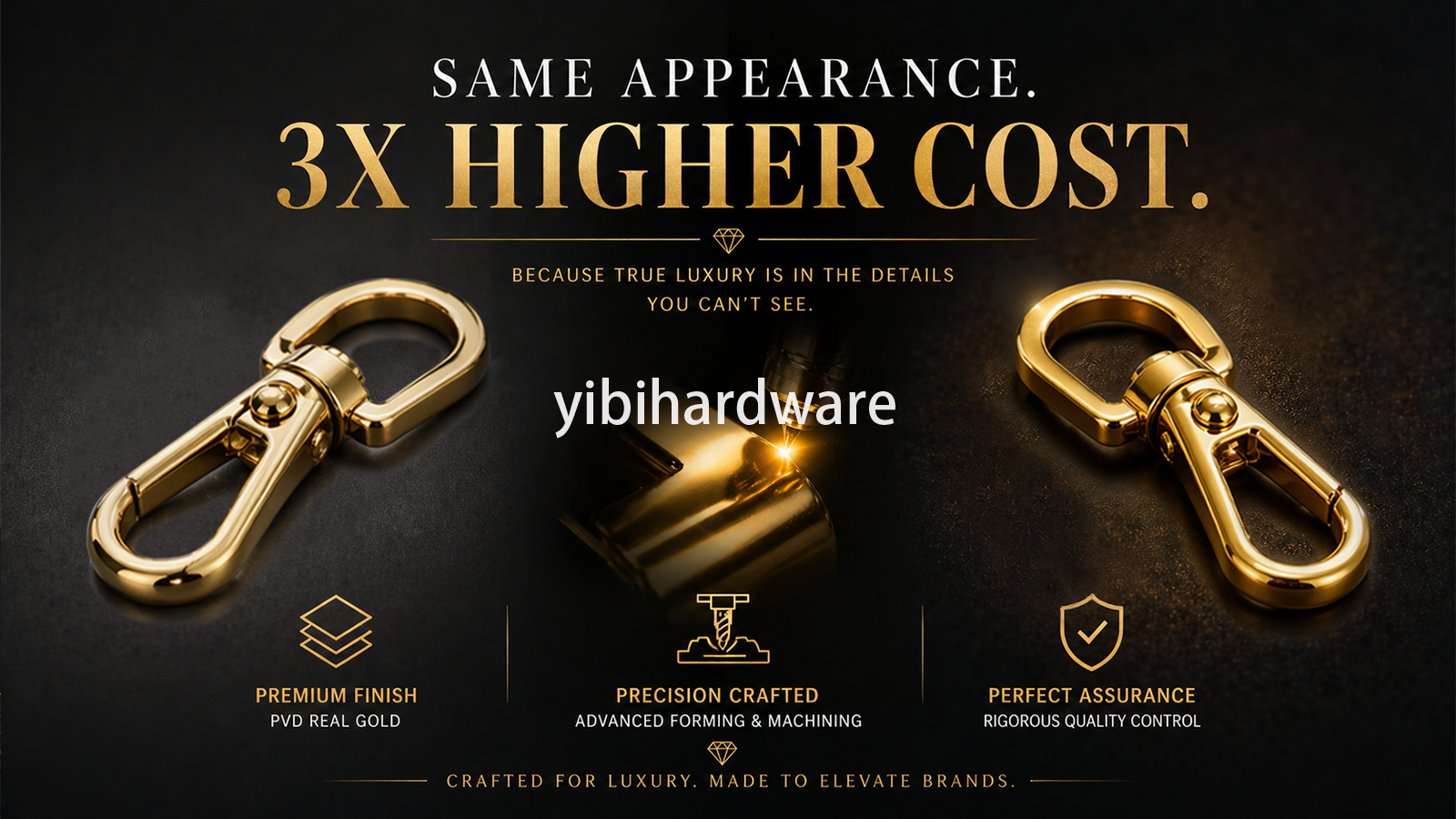
Stainless steel jewelry hardware is small in size, with complex curved surfaces, gaps and hollow-outs. Barely visible micron-level process differences lead to 2–3x cost gaps, and ultimately affect comfort, durability, hypoallergenic performance and batch stability — core quality metrics for mid-to-high-end products.
I. Surface Treatment (50%–60% of total cost, main price driver)
1. Grinding & Polishing (Coating foundation)
Low-cost: 1–2 rough tumbling steps (10–30s per piece). Obvious burrs are removed, yet micro-scratches, pits and dead-angle flaws remain (Ra ≥ 1.6μm). These cause skin irritation, coating pinholes, peeling and tarnishing.
High-end: 6–10 combined mechanical, manual and ultrasonic polishing procedures (5–20 mins per piece; over 30 mins for complex hollow parts). All contact edges and dead angles are fully finished, with surface roughness controlled at Ra ≤ 0.2μm. Coating adhesion triples for ultra-smooth, comfortable wear.
2. PVD Coating (Stainless steel excludes water electroplating)
Budget PVD: Basic vacuum evaporation with poor thickness & temperature control. Coating thickness fluctuates wildly, causing exposure or cracking. Bulk plating leads to uneven coverage, chromatic aberration and pitting. Using low-cost non-gold materials, it fades in 3–6 months and may trigger allergies.
Premium PVD: High-precision magnetron sputtering with strictly regulated coating thickness. We adopt 99.9% pure gold for molecular-level bonding with steel. The finish retains golden luster for 1–3 years, with excellent wear & corrosion resistance and zero allergy risks. Pure gold PVD alone costs 4–6 times standard versions.
3. Sealing & Anti-oxidation
Low-cost: No sealing treatment. Coating pinholes speed up oxidation and discoloration.
High-end: Nano or electrophoretic oil sealing fills pinholes, boosting corrosion resistance 2–3 times and preserving luster long-term.
II. Forming & Machining (25%–35% of total cost)
Mold & Forming: Budget rough molds (tolerance ±0.2mm) cause burrs, dimension errors and easy fracture. High-end precision molds (tolerance ±0.05mm) adopt multi-station forming, controlling batch error within 0.03mm and doubling structural strength.
Welding: Ordinary soldering/spot welding leaves bulky weak joints prone to damage and rust. Laser/argon arc seamless welding creates invisible joints (<0.5mm) with equal strength to the base material.
Drilling & Cutting: Traditional equipment brings deviations and burrs. Fiber laser processing achieves ±0.03mm positioning accuracy with smooth, burr-free ultra-fine holes.
III. Post-processing & QC (10%–15% of total cost)
Deburring & Cleaning: Cheap products leave tiny burrs and residual contaminants, hurting comfort and coating durability. Premium solutions apply full-range deburring and complete multi-stage cleaning for safe wear and firm coating adhesion.
Inspection: Budget products skip strict QC, with a 10%–30% defect rate. We conduct 100% full inspection covering appearance, dimension, tension and salt spray tests, keeping defect rate below 0.5%.
Conclusion